
So… your sweet, cuddly, obedient little puppy has suddenly developed selective hearing, endless energy, and a talent for chaos?
Welcome to adolescence.
If you’re reading this, chances are you’re in the middle of what many dog owners call the “teenage phase.” One day your pup sits perfectly for treats. The next day? They look at you like they’ve never heard the word “sit” in their entire life.
Take a deep breath. You’re not alone. And more importantly — this phase is completely normal.
Let’s walk through what’s really happening during puppy adolescence, when it starts, why your dog seems to have forgotten everything you taught them, and how you can survive it (and even strengthen your bond in the process).
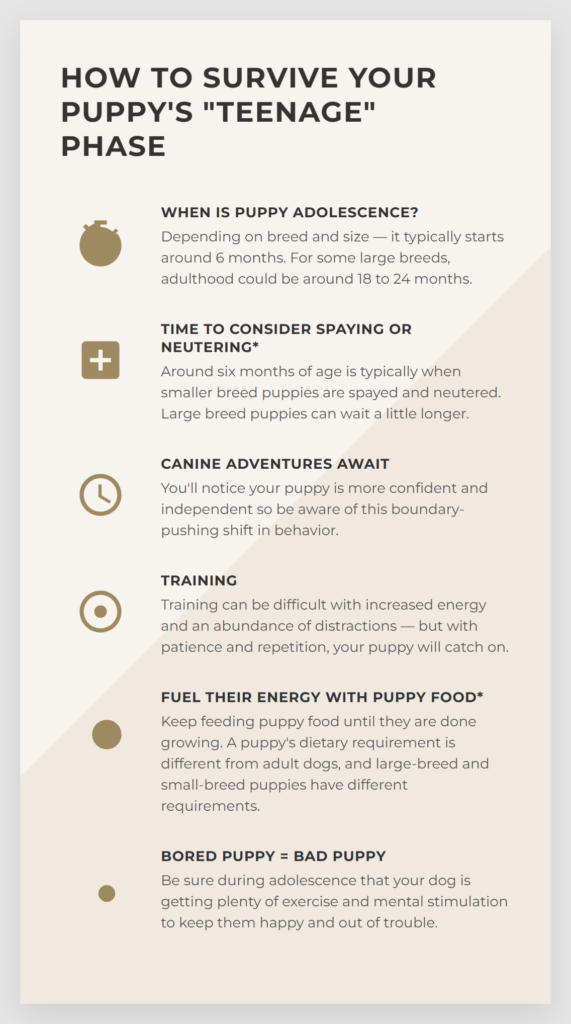
When Is Puppy Adolescence?
Puppy adolescence usually begins around 6 months of age, though it varies depending on breed and size.
- Small breeds tend to mature faster and may enter adolescence earlier.
- Large and giant breeds often develop more slowly and can remain in a teenage stage until 18 to 24 months.
Yes… potentially two whole years.
That doesn’t mean two years of chaos. But it does mean growth isn’t linear. Just when you think your dog has “figured it out,” you may see a temporary regression.
This stage is a transition from puppyhood to adulthood. Hormones shift. Confidence grows. Curiosity explodes. Boundaries get tested.
Sound familiar? It should. It’s very similar to human teenagers.
Why Your Puppy Suddenly “Forgot” Their Training
Let’s clear something up right away: your puppy did NOT forget their training.
What’s happening instead is:
- Increased independence
- Heightened curiosity
- Stronger environmental distractions
- Hormonal changes
- Confidence testing
Your puppy is learning how the world works. They’re asking, “Do I really have to listen? What happens if I don’t?”
It’s not defiance. It’s development.
Adolescence is when dogs start making choices instead of simply following instinct or routine. That’s actually a good sign — it means their brain is maturing.
The key? Consistency.
Time to Consider Spaying or Neutering
Around six months is often when smaller breeds are spayed or neutered. Larger breeds sometimes wait a bit longer depending on veterinary advice.
Hormonal changes during adolescence can bring:
- Marking behavior
- Mounting
- Increased roaming interest
- Reactivity toward other dogs
Spaying or neutering can influence some of these behaviors, but it’s not a magic switch. Training and management still matter.
Always talk to your veterinarian about timing based on your dog’s breed, size, and health.
The Confidence Explosion: “Canine Adventures Await”
You may notice your dog becoming more adventurous.
That timid puppy who hesitated at stairs? Now they’re sprinting up them.
That pup who stayed glued to your side? Now they’re suddenly interested in exploring the entire park.
Adolescent dogs:
- Push boundaries
- Test limits
- Explore independently
- Show bursts of boldness
This can be wonderful — confidence is a healthy sign of development. But it also means your dog might suddenly ignore recall in favor of chasing a squirrel.
This is the time to:
- Reinforce recall consistently
- Use long training leads in open areas
- Avoid unsafe off-leash situations
- Reward check-ins heavily
Confidence is good. Recklessness is not. Your job is to guide that energy safely.
Training During the Teenage Phase
Here’s the truth: training gets harder before it gets easier.
Adolescent dogs have:
- More energy
- Shorter attention spans
- Increased distractions
- Selective listening skills
But this is not the time to give up.
In fact, adolescence is when training matters most.
Go Back to Basics
Even if your dog “knows” sit, stay, down, or recall, revisit foundational training.
Practice:
- Short, high-reward sessions
- Training in low-distraction environments first
- Gradual increases in difficulty
Think of it like strengthening a muscle. Repetition builds reliability.
Make Training Fun
If your sessions feel repetitive or dull, your teenage dog will tune out.
Add:
- High-value treats
- Play rewards
- Quick 3–5 minute sessions
- Games like “find it” or hide-and-seek
Training shouldn’t feel like punishment. It should feel like teamwork.
Energy Management: A Bored Puppy = A Creative Puppy
There’s a saying among dog trainers:
“A bored puppy is a bad puppy.”
Not because they’re bad — but because they’ll invent their own entertainment.
And that entertainment often involves:
- Chewing furniture
- Digging
- Counter surfing
- Barking excessively
- Rearranging your trash
Adolescent dogs have higher stamina and more curiosity. They need:
- Daily physical exercise
- Mental stimulation
- Structured enrichment
Physical Exercise
This depends on breed and age, but consider:
- Structured walks
- Controlled fetch
- Tug games
- Supervised social play
- Hiking (age-appropriate)
Exercise isn’t just about exhaustion — it’s about engagement.
Mental Stimulation
Mental work tires dogs faster than physical work.
Try:
- Puzzle feeders
- Snuffle mats
- Training new tricks
- Scent games
- Food-dispensing toys
A 15-minute scent game can calm a dog more effectively than a long walk.
Feeding Through Adolescence: Keep the Puppy Food?
Yes — usually.
Puppies are still growing during adolescence, especially large breeds. Their nutritional needs differ from adult dogs.
- Puppy food supports bone development.
- Large breeds may need special growth formulas.
- Small breeds may transition sooner.
Don’t rush into adult food just because your dog looks bigger. Growth plates are still developing.
Always consult your vet for timing recommendations.
Regression Is Normal (And Temporary)
One of the most frustrating parts of adolescence is regression.
Your dog may:
- Start pulling on the leash again
- Suddenly bark at strangers
- Have accidents after months of success
- Ignore commands they previously mastered
It feels personal.
It’s not.
Regression happens because adolescent brains are reorganizing. Neural pathways are strengthening, shifting, and maturing.
The solution?
- Stay calm
- Revisit basics
- Avoid punishment-based reactions
- Increase supervision temporarily
This phase passes — especially if you remain consistent.
Social Changes: New Reactions to Dogs and People
Adolescent dogs often experience a secondary fear period.
You might notice:
- Sudden nervousness in familiar places
- Barking at strangers
- Hesitation around objects they once ignored
Do not force interactions.
Instead:
- Create positive associations
- Use treats at safe distances
- Let your dog approach at their own pace
Patience here prevents long-term anxiety.
Managing Destructive Behavior
Chewing peaks during adolescence — even after teething.
Why?
- Stress relief
- Boredom
- Exploration
- Habit
Management is your best friend.
- Rotate toys weekly
- Keep tempting objects out of reach
- Use crates or playpens appropriately
- Supervise when free-roaming
Don’t rely on yelling. Set your dog up for success instead.
Leash Manners May Fall Apart
That perfect heel? Gone.
Your dog is stronger now. More curious. More easily distracted.
Instead of expecting perfection:
- Reinforce loose leash walking in quiet areas
- Reward frequently
- Change directions often
- Use engagement games during walks
Remember: walks are stimulating environments. Your dog’s brain is processing a lot.
Emotional Survival for You
Let’s talk about something equally important — your feelings.
Adolescence can test your patience.
You might feel:
- Frustrated
- Overwhelmed
- Embarrassed in public
- Doubtful about your training skills
This is normal.
Many dog owners say adolescence is harder than early puppyhood.
Why? Because early puppies are clueless. Teenagers are opinionated.
But here’s the good news: if you stay consistent through this stage, adulthood is incredibly rewarding.
Boundaries Matter More Than Ever
Teenage dogs push limits.
If you allow something “just this once,” it may become a habit.
Decide early:
- Are they allowed on furniture?
- Are they allowed to jump on guests?
- Do they wait at doors?
Consistency builds clarity.
Dogs thrive when expectations are clear and predictable.
Channeling Independence Positively
Instead of fighting your dog’s independence, use it.
Teach:
- Advanced tricks
- Agility basics
- Nose work
- Rally obedience
- Structured fetch games
Adolescence is the perfect time to build new skills.
Confidence + guidance = powerful partnership.
When to Seek Professional Help
If your adolescent dog shows:
- Aggression
- Extreme anxiety
- Resource guarding
- Severe reactivity
- Unmanageable destructive behavior
Consult a certified trainer or veterinary behaviorist.
Early intervention prevents lifelong issues.
Asking for help isn’t failure — it’s responsibility.
The Light at the End of the Tunnel
Here’s what most owners don’t hear enough:
Adolescence ends.
And when it does, you’ll have:
- A confident adult dog
- A stronger bond
- Solid training foundations
- Shared experiences
The work you put in now shapes the adult your dog becomes.
This stage isn’t about perfection.
It’s about guidance.
Practical Survival Checklist
Let’s simplify everything into actionable steps:
✔ Short, fun training sessions daily
✔ Physical exercise suited to breed
✔ Mental enrichment activities
✔ Consistent boundaries
✔ Management over punishment
✔ Patience during regression
✔ Vet consultation about spaying/neutering
✔ Proper nutrition until growth finishes
✔ Safe social exposure
✔ Asking for help if needed
Final Thoughts: You’re Raising a Future Adult
Right now, it may feel chaotic.
But what you’re actually doing is raising a future adult companion.
The goofy, distracted, stubborn “teen” in your house today will become:
- The steady hiking partner
- The loyal family guardian
- The calm couch companion
- The confident social dog
Adolescence is a transition — not a destination.
Stay consistent. Stay patient. Keep showing up.
Your dog isn’t giving you a hard time.
They’re having a hard time figuring out how to grow up.
And with your guidance, they absolutely will. 🐾