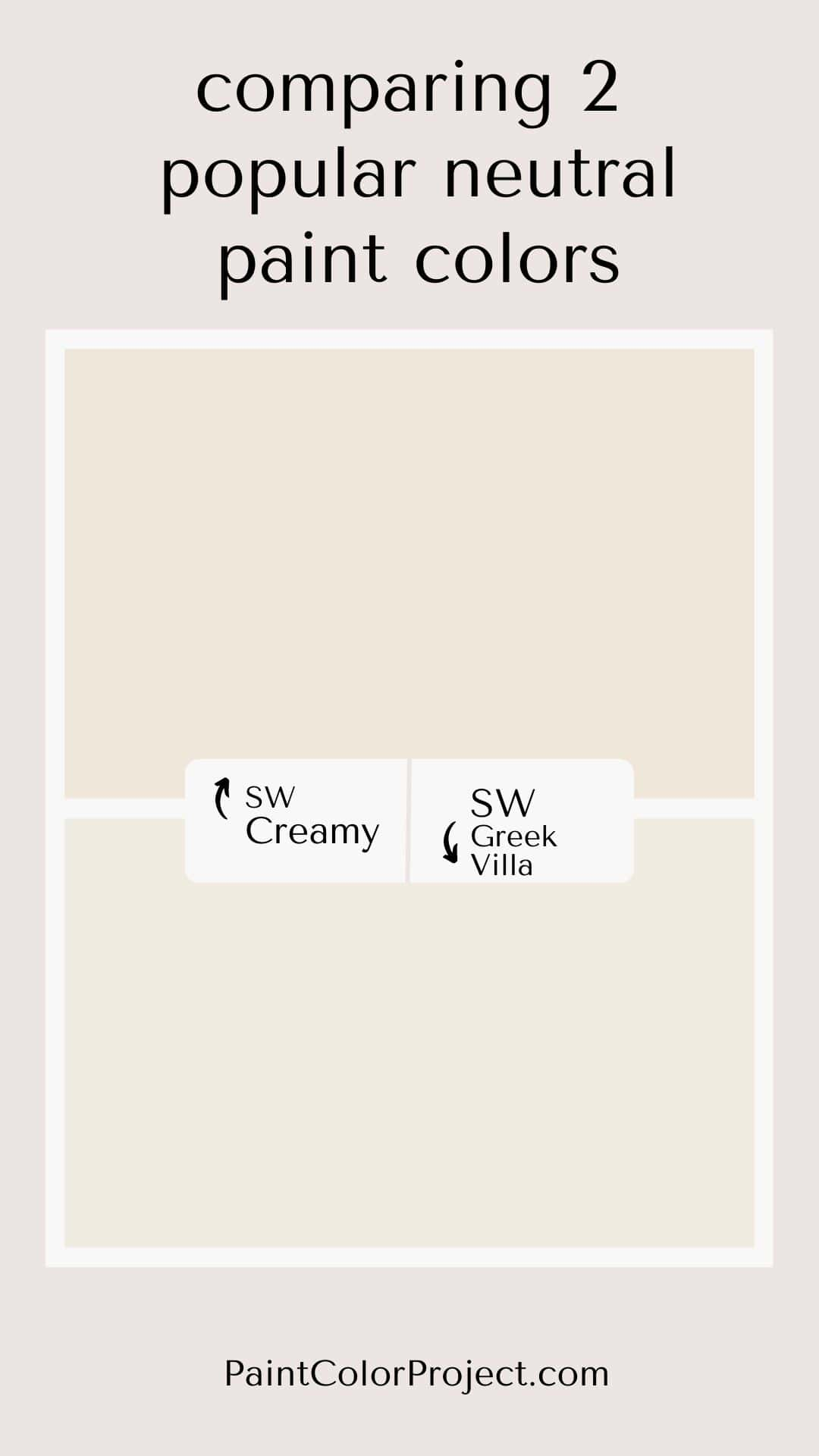
Choosing between two warm white paint colors can be surprisingly difficult.
On a small paint chip, Sherwin-Williams Creamy SW 7012 and Greek Villa SW 7551 may seem close enough that you wonder whether the difference really matters.
Once they’re on your walls, however, the distinction becomes much easier to see.
Both are warm whites.
Both are softer than a crisp architectural white.
Both work beautifully with wood, stone, beige, greige, brown, black, brass, and many of today’s popular earthy finishes.
But Creamy and Greek Villa don’t create exactly the same atmosphere.
Creamy SW 7012 is warmer, richer, and more obviously creamy.
Greek Villa SW 7551 is lighter, brighter, and generally closer to a traditional warm white.
Sherwin-Williams’ current technical data supports that difference. Creamy has an LRV of approximately 81.19, while Greek Villa has a higher LRV of approximately 84.22. Creamy also has slightly more saturation and a warmer yellow direction in its official color data.
That may sound like a tiny difference.
But with white paint, tiny differences matter.
Your flooring, furniture, kitchen cabinets, natural light, trim, countertops, and even light bulbs can push one color toward the perfect warm white while making the other appear too creamy.
So which should you choose?
This detailed comparison of Sherwin-Williams Creamy vs Greek Villa covers their undertones, LRV, lighting behavior, trim pairings, cabinets, wood tones, exteriors, whole-house use, and the situations where one clearly works better than the other.
Creamy vs Greek Villa at a Glance
| Feature | Creamy SW 7012 | Greek Villa SW 7551 |
|---|---|---|
| Brand | Sherwin-Williams | Sherwin-Williams |
| Color family | White & Pastel | White & Pastel |
| LRV | 81.19 | 84.22 |
| RGB | 239, 232, 219 | 240, 236, 226 |
| Hex | #EFE8DB | #F0ECE2 |
| Overall appearance | Warm creamy white | Bright warm white |
| Undertone | Soft yellow/cream | Warm, sunny cream |
| Brighter option | — | Yes |
| Warmer option | Yes | — |
| Interior/exterior | Both | Both |
| Best with warm wood | Excellent | Excellent |
| Best when you want obvious creaminess | Creamy | — |
| Best when you want a lighter warm white | — | Greek Villa |
Sherwin-Williams officially describes Creamy as a bright white with very soft yellow undertones, while Greek Villa is described as a sunny white that becomes especially lively in natural light.
Those descriptions capture the fundamental difference very well.
What Color Is Sherwin-Williams Creamy SW 7012?
Creamy SW 7012 is exactly what its name suggests: a warm, inviting creamy white.
But it isn’t an old-fashioned buttercream yellow.
The yellow influence is relatively restrained.
Sherwin-Williams describes Creamy as a bright white with soft yellow undertones that create subtle warmth. The company currently lists it for both interior and exterior use.
Its official specifications include:
- LRV: 81.191
- RGB: 239, 232, 219
- Hex: #EFE8DB
With an LRV just above 81, Creamy still reflects plenty of light.
It isn’t beige.
It isn’t tan.
It is absolutely within the white/off-white family.
But compared with Greek Villa, Creamy has more warmth and slightly more color.
Put Creamy next to a crisp cool white and its creamy character becomes obvious.
Place it beside natural oak, beige stone, cream upholstery, and warm metals, however, and it may simply look like a beautifully soft white.
That’s why context matters so much.
What Color Is Sherwin-Williams Greek Villa SW 7551?
Greek Villa SW 7551 is another warm Sherwin-Williams white, but it is lighter and a little less saturated than Creamy.
Sherwin-Williams describes Greek Villa as a sunny white that comes to life in natural light, noting that it can be used both to brighten a space and on trim to make neighboring colors stand out.
Its current specifications include:
- LRV: 84.223
- RGB: 240, 236, 226
- Hex: #F0ECE2
That higher LRV makes Greek Villa noticeably closer to bright-white territory.
It isn’t a crisp cool white.
There is still warmth.
But when Creamy and Greek Villa are placed side by side, Greek Villa usually feels a little fresher and Creamy feels a little richer.
Greek Villa is particularly attractive in rooms where pure white would feel too sterile but you don’t want the walls to read obviously cream.
The Biggest Difference Between Creamy and Greek Villa
If you remember only one thing from this comparison, remember this:
Creamy is warmer.
Greek Villa is brighter.
Creamy’s LRV is approximately 81.19.
Greek Villa’s LRV is approximately 84.22.
A three-point LRV difference isn’t enormous, but white paint is incredibly sensitive to small changes.
Their RGB values also tell the story.
Creamy contains:
239 red / 232 green / 219 blue
Greek Villa contains:
240 red / 236 green / 226 blue
Greek Villa contains proportionally more green and blue relative to red, which reduces some of the obvious creaminess.
Creamy has a larger separation between its red and blue channels, reinforcing the warmer visual character.
You don’t need to understand color science to choose between them, but the numbers explain why people often perceive Creamy as more yellow or cream-colored.
Creamy vs Greek Villa Undertones
Neither of these is a completely neutral white.
Both belong firmly to the warm-white family.
But their undertones aren’t identical.
Creamy undertones
Sherwin-Williams directly describes Creamy as having soft yellow undertones.
In practical terms, Creamy can show:
- Soft yellow
- Cream
- Warm ivory
- Subtle beige warmth
It shouldn’t normally look like bright yellow paint.
The undertone is much more restrained than that.
But if you place Creamy next to an icy white countertop or blue-white trim, its warmth can become dramatically more visible.
Greek Villa undertones
Greek Villa is also warm, but its warmth generally feels lighter.
Sherwin-Williams describes it as “sunny,” which is a useful way of thinking about the color.
You may notice:
- Cream
- Soft warm beige
- Gentle yellow warmth
But Greek Villa tends to stay closer to white than Creamy.
Which Is More Yellow: Creamy or Greek Villa?
Creamy is the more yellow of the two.
That doesn’t mean Creamy is yellow paint.
It means its warm undertone is easier to see.
Sherwin-Williams explicitly identifies the soft yellow undertone in Creamy, while its data also shows Creamy as slightly more saturated than Greek Villa.
If you strongly dislike any suggestion of cream or yellow, Greek Villa is probably the safer sample to start with.
If you specifically want a warm, comfortable white that looks beautiful beside natural materials, Creamy’s extra warmth may be exactly what your room needs.
Which Is Whiter: Creamy or Greek Villa?
Greek Villa.
Its higher LRV means it reflects more light.
Greek Villa sits at approximately 84.22 compared with Creamy’s 81.19.
Greek Villa’s official RGB values are also slightly higher overall.
That translates into a paint color that generally feels a little lighter.
However, neither is a crisp paper white.
If you place either one next to a clean, high-LRV neutral white, you’ll see warmth.
Think of Greek Villa as:
warm white
and Creamy as:
creamy warm white.
Creamy vs Greek Villa in North-Facing Rooms
North-facing rooms usually receive cooler, more indirect daylight.
Warm whites can be useful here because they help counterbalance that coolness.
Creamy in northern light
Creamy can be an excellent choice if your north-facing room feels cold or gray.
Its yellow warmth can compensate for blue-toned daylight.
Instead of looking intensely creamy, it may settle into a softer neutral white.
This is especially attractive with:
- Warm oak
- Medium wood
- Cream furniture
- Beige rugs
- Brown leather
- Brass lighting
If the room is very dark, however, Creamy’s lower LRV means it may feel somewhat heavier than Greek Villa.
Greek Villa in northern light
Greek Villa’s higher LRV gives it an advantage when brightness matters.
The cooler natural light can also calm some of its warmth.
This often allows Greek Villa to appear balanced and relatively neutral.
North-facing winner:
Greek Villa if the room is dark and you want maximum brightness.
Creamy if the room feels cold and you specifically want extra warmth.
Creamy vs Greek Villa in South-Facing Rooms
South-facing rooms receive warmer, stronger natural light.
This is where the difference between these two whites can become more obvious.
Creamy in southern light
Expect Creamy to warm up.
Its yellow/cream undertones may become significantly more noticeable during bright parts of the day.
This can look gorgeous in a room inspired by:
- Mediterranean interiors
- Traditional design
- Warm farmhouse
- English cottage style
- Organic natural palettes
But if you want a relatively clean white, Creamy may become warmer than you’d like.
Greek Villa in southern light
Greek Villa also warms up, but because it begins slightly brighter and less saturated, it can maintain more of its white appearance.
You’ll still see creaminess.
But generally not as much as with Creamy.
South-facing winner:
Greek Villa for a lighter warm white.
Creamy if you intentionally want a rich, sunny atmosphere.
Creamy vs Greek Villa in East-Facing Rooms
East-facing rooms receive strong warmer sunlight in the morning and cooler light later.
Creamy can look beautifully warm early in the day.
As direct sunlight fades, it may become calmer and slightly more neutral.
Greek Villa will also warm in the morning but tends to retain a somewhat brighter quality throughout the day.
For bedrooms, either can work exceptionally well.
Choose Creamy if you want coziness.
Choose Greek Villa if you want freshness.
Creamy vs Greek Villa in West-Facing Rooms
West-facing rooms typically become dramatically warmer in late afternoon.
That golden light can intensify warm whites.
Creamy may look particularly creamy around sunset.
Greek Villa may also warm considerably but generally stays lighter.
If your western room already contains honey oak flooring, beige furniture, warm stone, and golden afternoon light, test Creamy carefully.
It may create an extremely warm palette.
That can be beautiful—but it should be intentional.
Creamy vs Greek Villa in Windowless Rooms
Without natural light, artificial lighting controls everything.
Under warm bulbs
Creamy may appear significantly warmer and more yellow.
Greek Villa will also warm but typically remains closer to white.
Under cool LEDs
Both may appear more neutral.
However, very cool lighting can make warm whites feel slightly disconnected from the rest of the room.
Under balanced neutral lighting
You’ll usually get the clearest sense of the true difference:
Creamy is richer.
Greek Villa is lighter.
Windowless-room winner:
Greek Villa if brightness is your priority.
Which Is Better for a Whole House?
Both can work as whole-house whites.
The difference comes down to how warm you want the overall interior to feel.
Choose Creamy throughout the house when:
Your home contains lots of warm wood.
You love traditional or cozy interiors.
Your fixed finishes are cream, beige, brown, or warm stone.
Your rooms receive cooler daylight.
You want the paint to feel intentionally warm.
Choose Greek Villa throughout the house when:
You want something closer to a traditional warm white.
Your home has mixed warm and neutral finishes.
You have an open floor plan and want slightly more light reflection.
You use natural oak but also black, charcoal, or more contemporary finishes.
You want warmth without as much visible cream.
Whole-house winner:
For sheer versatility, Greek Villa has a slight advantage.
For a deliberately warm interior, Creamy can be exceptional.
Creamy vs Greek Villa With White Oak
White oak is one of today’s most popular wood finishes.
Both whites work beautifully with it.
Creamy + white oak
This combination is warm, soft, and organic.
Use it with:
- Beige limestone
- Linen upholstery
- Brass
- Terracotta
- Cream textiles
- Olive green
This can create a gorgeous organic-modern or Mediterranean-inspired room.
Greek Villa + white oak
Greek Villa gives white oak slightly more contrast.
The overall effect remains warm but feels a bit lighter and cleaner.
Add:
- Black accents
- Cream fabrics
- Charcoal
- Brass
- Mushroom
- Sage
White-oak winner:
Greek Villa for modern organic interiors.
Creamy for warmer traditional or Mediterranean interiors.
Creamy vs Greek Villa With Honey Oak
Honey oak is where you need to be particularly careful.
Honey oak already contains strong golden, yellow, and orange undertones.
Creamy with honey oak
This can create an extremely warm room.
Sometimes that is wonderful.
Sometimes it becomes too much.
If your oak is moderately warm and the room has cooler northern light, Creamy may soften the wood beautifully.
But if the wood is strongly orange and the room gets golden southern or western light, the combination can become overwhelmingly warm.
Greek Villa with honey oak
Greek Villa generally gives you a little more breathing room.
It’s still warm enough that it doesn’t create harsh contrast with the wood.
But because it’s brighter and slightly less creamy, it may prevent the palette from becoming too yellow.
Honey-oak winner:
Greek Villa.
Creamy vs Greek Villa With Walnut
Walnut is much easier.
Its deep brown color provides strong natural contrast.
Both whites can look fantastic.
Creamy + walnut
Feels rich, traditional, and luxurious.
Add:
- Brass
- Cream linen
- Olive
- Leather
- Warm stone
Greek Villa + walnut
Feels slightly fresher and more contemporary.
Add:
- Black
- Cream
- White oak accents
- Beige
- Charcoal
Walnut winner:
Tie.
Choose based on how warm you want the overall room.
Creamy vs Greek Villa With Cherry Wood
Cherry wood contains strong red or reddish-brown undertones.
Creamy’s yellow warmth can reinforce the overall warm appearance.
That may suit traditional interiors, but it can also make the room feel heavily warm-toned.
Greek Villa gives you a slightly lighter backdrop.
For many cherry-wood interiors, I’d start by sampling Greek Villa first.
However, neither should be chosen without putting the sample directly next to the wood.
Creamy vs Greek Villa With Dark Wood
Dark espresso, ebony, and deep brown wood look excellent with both colors.
The high contrast allows each white to maintain its own identity.
Creamy softens dark wood and creates a classic atmosphere.
Greek Villa makes the room feel brighter and slightly more contemporary.
This is largely a style decision.
Creamy vs Greek Villa for Kitchen Cabinets
Warm white kitchen cabinets have become an attractive alternative to stark bright-white cabinetry.
Both Creamy and Greek Villa can work, but they produce noticeably different results.
Creamy kitchen cabinets
Creamy cabinets have a soft, furniture-like quality.
They’re especially attractive with:
- Warm quartz
- Cream marble
- Travertine
- Beige stone
- Medium oak floors
- Walnut islands
- Brass hardware
- Bronze
This is not the cabinet color to choose if you want a crisp white kitchen.
Creamy’s soft yellow undertones are real and Sherwin-Williams specifically identifies them in the official description.
But if you want warm cabinetry, that’s exactly the appeal.
Greek Villa kitchen cabinets
Greek Villa is brighter.
It works beautifully with:
- White oak
- Walnut
- Warm quartz
- Marble
- Black hardware
- Brass
- Muted green
- Warm gray
Sherwin-Williams showcases Greek Villa in real kitchens as well as bathrooms, living rooms, and exteriors, demonstrating its versatility across applications.
Cabinet winner:
Greek Villa for a lighter warm-white kitchen.
Creamy for intentionally creamy cabinetry.
Creamy vs Greek Villa With White Quartz
White quartz is tricky because “white” quartz can have different undertones.
If your quartz is very cool or blue-white, Creamy may look distinctly yellow beside it.
Greek Villa may work better, but it can still show warmth.
If your quartz has creamy, beige, or warm veining, Creamy may be perfect.
Put physical samples directly beside the countertop before choosing.
Do not rely on the product name alone.
Creamy vs Greek Villa With Marble
The same rule applies to marble.
Warm marble containing cream, beige, or gold veining can work beautifully with Creamy.
Cool Carrara-style marble with blue-gray veining may be easier with Greek Villa.
Neither is automatically right for every slab.
Natural stone contains too much variation for blanket rules.
Best Trim Color With Creamy
You have two main approaches.
Creamy walls + Creamy trim
This is one of the safest and most sophisticated options.
Use:
- Lower sheen on walls
- Satin or semi-gloss on trim
The room feels seamless.
You also avoid creating an undertone battle between two different whites.
Creamy walls + brighter white trim
This creates more contrast.
But be aware:
A cleaner white will make Creamy look noticeably more yellow.
If you love that warm contrast, great.
If you don’t want to see creaminess, use Creamy on both walls and trim instead.
Best Trim Color With Greek Villa
Greek Villa is particularly flexible because Sherwin-Williams itself notes that the color can be used on trim to help other colors stand out.
Again, you have two options.
Greek Villa walls + Greek Villa trim
This creates a beautiful tonal room.
Especially good for:
- Organic modern
- Mediterranean-inspired
- Minimalist interiors
Greek Villa walls + cleaner white trim
This creates more architectural definition.
But, as with Creamy, the brighter trim will make Greek Villa’s warmth more obvious.
There is no escaping relative color perception.
Can You Use Creamy and Greek Villa Together?
Technically, yes.
But I generally wouldn’t choose them as two contrasting whites in the same room.
Why?
Because they’re too similar.
Greek Villa is lighter.
Creamy is warmer.
Placed directly together, there’s a risk that Creamy simply looks yellowed or dirty rather than intentionally different.
For example:
Greek Villa walls + Creamy trim
is not a combination I’d automatically recommend.
Similarly:
Creamy walls + Greek Villa cabinets
could work, but only after careful sampling.
When using two whites, you often get a more successful result when the difference is clearly intentional.
Creamy vs Greek Villa for Bedrooms
Bedrooms are ideal for warm whites because softness matters more than extreme brightness.
Creamy bedroom
Feels:
- Cozy
- Warm
- Relaxed
- Traditional
- Soft
Use with:
Walnut, oak, cream linen, muted green, tan, brass, and terracotta.
Sherwin-Williams has featured Creamy in bedrooms and positioned it as an easy-to-pair off-white.
Greek Villa bedroom
Feels:
- Brighter
- Warm
- Airy
- Natural
- Relaxed
Use with:
White oak, oatmeal linen, mushroom, sage, black, and warm brass.
Bedroom winner:
Creamy for coziness.
Greek Villa for brightness.
Creamy vs Greek Villa for Living Rooms
Living rooms can handle either color very easily.
Choose Creamy if the room contains lots of:
- Brown
- Antique furniture
- Warm oak
- Cream upholstery
- Traditional stone
Choose Greek Villa if the room contains more:
- White oak
- Black
- Charcoal
- Contemporary furniture
- Mixed warm and cool neutrals
Greek Villa’s slightly lighter character generally makes it easier in open living spaces.
Creamy vs Greek Villa for Bathrooms
Bathrooms often contain fixed whites.
This is where you need to be careful.
A bright-white bathtub, toilet, or sink can make Creamy look significantly more yellow.
Greek Villa can also appear warm beside white porcelain, but the contrast is typically less dramatic.
If your bathroom contains:
- Bright white subway tile
- Cool marble
- White porcelain
start with Greek Villa.
If it contains:
- Travertine
- Cream tile
- Warm stone
- Natural wood vanity
- Brass
Creamy may be beautiful.
Creamy vs Greek Villa for Exteriors
Both colors are officially listed for interior and exterior use.
And both can be excellent exterior whites.
Remember that exterior sunlight makes paint appear considerably lighter.
Creamy exterior
Creamy works especially well with:
- Brown roofs
- Warm stone
- Brick
- Cedar
- Bronze
- Dark brown shutters
Outside, its warmth can keep a large home from looking glaringly white.
Greek Villa exterior
Sherwin-Williams currently showcases Greek Villa on real-home exteriors as well as interiors.
Greek Villa works particularly well with:
- Black windows
- Natural wood doors
- Charcoal roofing
- Stone
- Bronze
- Deep green
Because Greek Villa is slightly brighter, it tends to create a lighter exterior appearance.
Exterior winner:
Greek Villa for a brighter warm-white exterior.
Creamy for homes with particularly warm stone, brick, or roofing.
Official Coordinating Colors for Creamy
Sherwin-Williams currently lists:
Studio Taupe SW 7549
and
Reynard SW 6348
as coordinating colors for Creamy.
That tells you a lot about Creamy’s personality.
Studio Taupe continues the warm neutral direction.
Reynard introduces a rich earthy warmth.
Creamy naturally belongs with palettes that include:
- Taupe
- Brown
- Rust
- Camel
- Warm wood
- Olive
- Brass
- Terracotta
This is a very earthy white.
Official Coordinating Colors for Greek Villa
Sherwin-Williams currently lists:
Illusive Green SW 9164
and
In the Navy SW 9178
as coordinating colors for Greek Villa.
That’s an interesting contrast with Creamy’s recommended palette.
Greek Villa’s pairings show how comfortably the color works with both muted green and deep navy.
This makes Greek Villa extremely easy to use in contemporary interiors.
Try:
Greek Villa walls
Illusive Green cabinetry
Oak furniture
Black accents
or:
Greek Villa walls
In the Navy island
Walnut
Brass
Both palettes give you much more contrast than an all-cream room.
Which Looks Better With Green?
Both are excellent with green.
Creamy works particularly well with:
- Olive
- Moss
- Warm sage
- Khaki green
- Earthy forest green
Greek Villa works particularly well with:
- Sage
- Gray-green
- Eucalyptus
- Deep forest green
- Muted green-gray
Sherwin-Williams officially pairs Greek Villa with Illusive Green, reinforcing this direction.
If the green is cool and gray, Greek Villa may transition more naturally.
If the green is warm and olive, Creamy can be gorgeous.
Which Looks Better With Navy?
Greek Villa has a slight advantage.
Sherwin-Williams directly lists In the Navy SW 9178 as a coordinating color for Greek Villa.
The dark cool blue contrasts beautifully with Greek Villa’s warmth.
Creamy can also work with navy, but the contrast may make Creamy’s yellow undertone more noticeable.
That’s not necessarily unattractive.
It simply creates a more traditional warm-and-cool palette.
Which Looks Better With Black?
Both.
Black makes warm whites feel more contemporary.
Creamy + black produces strong contrast between warmth and depth.
Greek Villa + black feels slightly cleaner.
For modern organic or contemporary farmhouse interiors, I’d generally lean toward Greek Villa.
For a warmer traditional interior with black accents, Creamy is excellent.
Which Looks Better With Brass?
This is an easy one:
Both.
Brass reinforces warmth, so it naturally works with Creamy.
Greek Villa and brass also create a beautiful warm but brighter palette.
If you use Creamy, incorporate some black, dark wood, or charcoal to keep everything from becoming overly golden.
Creamy vs Greek Villa for an Open Floor Plan
Open layouts benefit from colors that can handle multiple exposures.
Greek Villa’s higher LRV and slightly lower saturation generally give it an advantage.
It moves relatively easily between:
Kitchen.
Dining area.
Living room.
Hallway.
Creamy can still work beautifully, especially if the entire house contains warm materials.
But if one part of your open floor plan receives strong western sunlight, Creamy’s warmth may intensify dramatically there.
Open-plan winner:
Greek Villa.
Creamy vs Greek Villa for Traditional Homes
Creamy may actually have the advantage here.
Traditional interiors often contain:
- Cherry
- Mahogany
- Oak
- Persian rugs
- Cream fabrics
- Brass
- Antique furniture
- Warm stone
Creamy’s richer warmth fits naturally into that environment.
Greek Villa can work too, but may look slightly cleaner and more updated.
Creamy vs Greek Villa for Modern Homes
Greek Villa wins.
Its brighter appearance makes it easier to pair with:
- White oak
- Black windows
- Minimal cabinetry
- Concrete
- Linen
- Sculptural furniture
- Charcoal
You still get warmth, but without as much creaminess.
Creamy vs Greek Villa for Modern Farmhouse
Greek Villa is usually the easier choice.
It provides the warm white farmhouse look while remaining lighter than Creamy.
Combine Greek Villa with:
- Black
- Oak
- Deep green
- Navy
- Warm gray
Creamy can still work, particularly in a more traditional farmhouse where warmth is a major part of the aesthetic.
Creamy vs Greek Villa for Organic Modern Interiors
Again, Greek Villa has a slight edge.
Organic-modern interiors often use:
- White oak
- Limestone
- Travertine
- Linen
- Mushroom
- Black
- Olive
Greek Villa provides a relatively quiet backdrop for those materials.
However, if your organic palette is heavily Mediterranean and dominated by warm stone, Creamy can be even better.
Is Creamy Too Yellow?
It can be—for the wrong room.
Sherwin-Williams openly describes Creamy as having soft yellow undertones.
So if you absolutely do not want to see yellow, don’t expect Creamy to behave like a neutral crisp white.
Creamy’s warmth is a feature, not a defect.
It becomes problematic when paired with finishes that don’t support it.
Examples include:
- Blue-white quartz
- Icy marble
- Very cool gray flooring
- Bright cool-white cabinetry
In a warm room, Creamy can look beautiful.
Is Greek Villa Too Yellow?
Greek Villa can still look creamy, particularly under strong warm light.
But compared directly with Creamy, it is typically the less yellow choice.
Its higher LRV and lower saturation help it retain more white character.
If you’re worried that Creamy will be too warm, Greek Villa is the logical next sample.
Can Either Color Look Dingy?
Yes.
Almost every warm white can look dingy when placed beside a much cleaner white.
Imagine Creamy walls beside a very bright blue-white door.
Creamy’s warmth suddenly becomes exaggerated.
Greek Villa can experience the same problem, although somewhat less strongly.
Before choosing either color, compare it with every important fixed white:
- Countertops
- Bathtub
- Sinks
- Tile
- Existing cabinets
- Window frames
- Appliances
- Trim
This may determine your choice faster than anything else.
Creamy vs Greek Villa: Which Is More Timeless?
Both are timeless in the right house.
Creamy belongs to the long tradition of soft ivory and warm white interiors.
Greek Villa provides a slightly cleaner version of that look.
Sherwin-Williams continues to actively feature both colors. Creamy has been highlighted as a Color of the Month and described as a timeless, easy-to-pair off-white, while Greek Villa remains among the company’s prominent warm whites and is showcased across kitchens, living rooms, bathrooms, and exteriors.
Neither color depends heavily on a short-lived design trend.
Who Should Choose Creamy SW 7012?
Choose Creamy if:
- You genuinely want a creamy white.
- Your home contains warm wood.
- Your stone or countertops lean cream or beige.
- Your rooms receive cool northern light.
- You love cozy traditional interiors.
- You have brown or warm roofing on an exterior.
- You use brass, bronze, leather, and earthy colors.
- Bright whites feel too sterile.
- You want more warmth than Greek Villa provides.
Creamy is particularly good when the home itself already speaks a warm visual language.
Who Should Choose Greek Villa SW 7551?
Choose Greek Villa if:
- You want a warm white but not an obviously creamy one.
- Maximum brightness matters.
- Your home contains white oak.
- You have an open floor plan.
- You like organic-modern interiors.
- You’re mixing warm and cool neutral materials.
- You want warm-white cabinetry.
- You have black windows or accents.
- You want a light exterior white that doesn’t look harsh.
- Creamy seems too yellow in your room.
Greek Villa is often easier when you’re trying to balance warmth with a relatively clean appearance.
Creamy vs Greek Villa: Which Is Better Overall?
If I had to recommend just one color without seeing the home, Greek Villa would be the more versatile starting point.
Why?
Its LRV of approximately 84.22 gives it greater brightness than Creamy’s 81.19.
It remains warm.
It works beautifully with wood.
It can be used on walls, cabinets, trim, and exteriors.
Sherwin-Williams even recommends it as a trim option for helping neighboring colors stand out.
And its official pairings with Illusive Green and In the Navy demonstrate that it can handle both earthy and high-contrast palettes.
But this doesn’t make Creamy inferior.
If your room needs warmth, Creamy might be considerably better.
Sherwin-Williams describes Creamy specifically as a bright white warmed by soft yellow undertones and pairs it with earthy Studio Taupe and Reynard.
That combination can be stunning in a home with oak, walnut, warm stone, leather, beige, olive, and brass.
The difference isn’t really:
good white vs bad white.
It’s:
How much warmth do you want?
Final Verdict: Creamy or Greek Villa?
Here is the simplest possible answer.
Choose Sherwin-Williams Creamy SW 7012 if you want:
A soft, rich, noticeably creamy warm white.
Creamy has an LRV of 81.191, with RGB values of 239, 232, 219. Sherwin-Williams specifically identifies its subtle yellow undertones and recommends pairing it with other warm colors such as Studio Taupe and Reynard.
It is especially beautiful with:
- Walnut
- Medium oak
- Warm stone
- Cream
- Beige
- Olive
- Brown
- Brass
- Bronze
- Traditional furnishings
Choose Sherwin-Williams Greek Villa SW 7551 if you want:
A lighter, brighter warm white with less obvious creaminess.
Greek Villa has an LRV of 84.223, RGB values of 240, 236, 226, and Sherwin-Williams describes it as a sunny white that responds beautifully to natural light.
It is especially beautiful with:
- White oak
- Walnut
- Sage
- Gray-green
- Navy
- Black
- Charcoal
- Brass
- Warm stone
- Contemporary furniture
For a traditional, cozy, cream-forward house, I’d start with Creamy.
For an open, light-filled, organic-modern or transitional home, I’d start with Greek Villa.
For honey oak, I’d generally sample Greek Villa first.
For warm limestone or travertine, I’d absolutely include Creamy.
For kitchen cabinets, Greek Villa is usually the safer choice if you still want them to look white.
For an exterior surrounded by warm stone or brick, Creamy may be fantastic.
And if you want one warm white to flow through an entire contemporary home, Greek Villa probably has the edge.
Most importantly, test both colors in your actual house.
Sherwin-Williams warns that colors displayed on computer monitors may not accurately represent real paint and recommends checking physical color samples before making a final choice.
Place Creamy and Greek Villa side by side.
Check them beside your flooring.
Move them next to your countertops.
Look at them beside your kitchen cabinets.
Compare them with the existing trim.
Check them in morning light.
Look again at midday.
Then turn on your lights after sunset.
With warm whites, the room almost always makes the final decision.
Creamy and Greek Villa are close enough that either can look beautiful—but different enough that one will usually feel noticeably more natural with the materials already in your home.
Creamy is the warmer choice.
Greek Villa is the brighter choice.
And once you decide which of those two qualities your home needs more, choosing between them becomes much easier.